

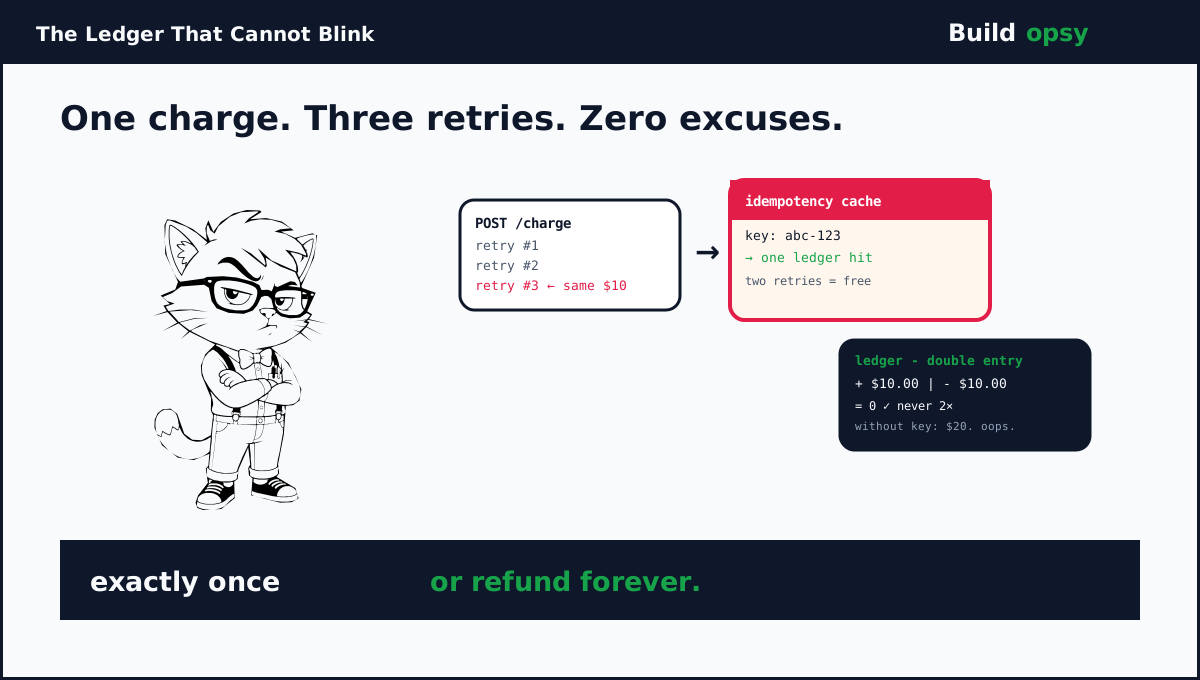
1. The Double Charge You Cannot Explain
A client can lose the response to a payment request without knowing whether the server completed it. Retrying with the same idempotency key lets a client safely repeat an eligible request without creating the operation again. Stripe documents this behavior for its API; the exact application still needs to distinguish a retry of the same operation from a new payment request.
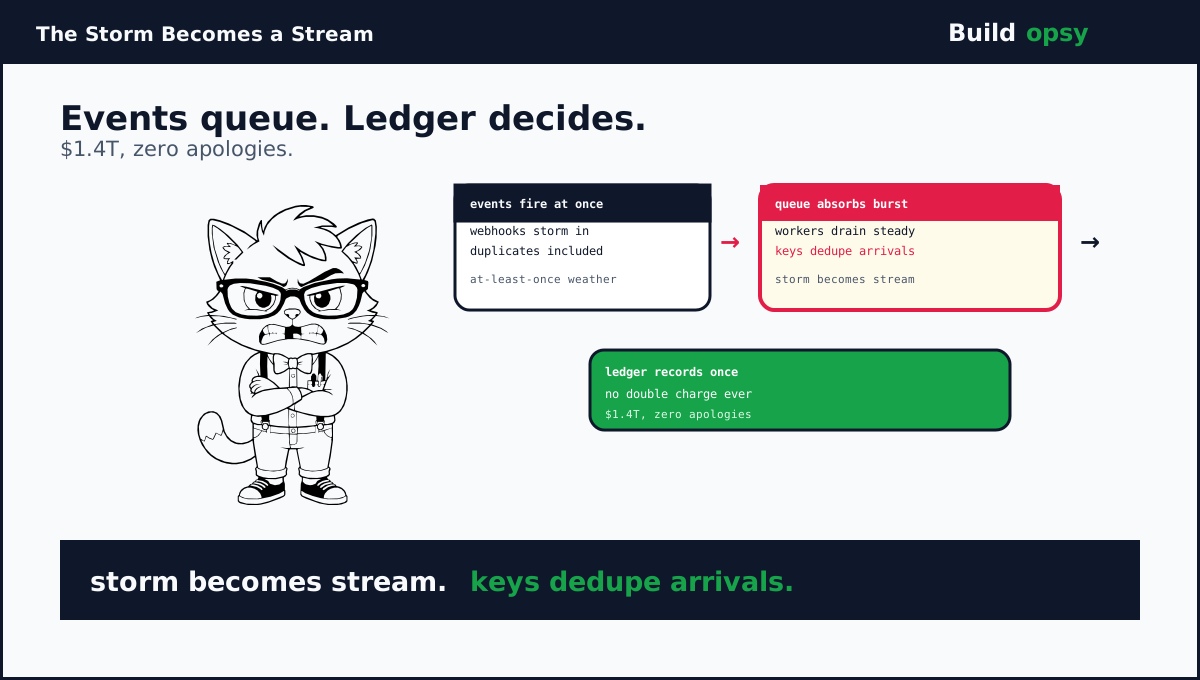
Webhook delivery has a separate failure mode. Stripe says live-mode events can be retried for up to three days with exponential backoff, and delivery order is not guaranteed. Receivers need to identify duplicate events and process them safely. This is a correctness problem, not evidence of a particular Stripe outage or retry volume.
Networks retry under ordinary failure conditions. The API contract should define which requests can be retried and how the client identifies the same operation.
2. What Stripe Discloses
Stripe reported $1.4 trillion in total payment volume for calendar year 2024, up 38% year over year. That is dollar volume, not a count of payments. The disclosure does not provide an average payment size, request rate, retry rate, ledger entry count, or infrastructure bill. The rate estimates later in this article therefore use explicit scenario inputs.
Stripe's API documentation explains that an idempotency key lets a client safely retry an eligible request. For API v1, Stripe saves the first response after endpoint execution begins and may remove keys only after they are at least 24 hours old. Its webhook documentation says live events can be retried for up to three days and may arrive out of order. These are documented API behaviors; they do not establish Stripe's internal ledger or deployment topology.
Cost depends on the workload and architecture. Without a published transaction count and unit-cost data, an estimate of Stripe's own infrastructure spend would be invented. The model below describes how an operator can make a scenario instead.
3. Reconstructing the Machine
The following is a generic reference model, not a description of Stripe's private architecture. A payment API can validate a request, use a durable idempotency record to recognize a retry, and commit the money movement under the consistency rules required by the product. The client should receive the saved outcome when it repeats the same eligible request.
Systems often send notifications and analytics through asynchronous queues after the authoritative transaction commits. A receiver can track processed event IDs, tolerate duplicate delivery, and avoid relying on event order. The separation between the authoritative write and downstream work is a design option to evaluate against the system's correctness and latency requirements.
4. Idempotency: Store the Operation Result
Stripe's current API v1 documentation says idempotency results may be pruned after they are at least 24 hours old. A request that reuses a key after its original result has been pruned can be treated as a new request. The documentation also says Stripe does not save a result when validation fails or a concurrent request conflicts before endpoint execution begins. Callers should generate unique keys for individual operations and preserve the same key when retrying that operation.
Do not treat idempotency as a best-effort cache. The system must preserve enough state to distinguish a retry from a new operation, and its expiration policy must be part of the API contract. A hypothetical duplicate volume can be calculated as requests per day × duplicate fraction; neither input is published in Stripe's 2024 volume announcement.
In a generic design, slow completion can make concurrent retries wait longer for the first operation's result. Measure that behavior from the actual service rather than assuming a particular lock, cache, or edge lookup exists inside Stripe.
5. A Modeled Payment Rate from $1.4T
Stripe's reported $1.4T is dollar volume, so it cannot be converted into a payment rate without an assumed average payment size. For this scenario, assume $50 per payment and use the 366-day 2024 calendar year: $1.4T ÷ $50 = about 28B modeled payments/year. Dividing by 31,622,400 seconds gives about 885 payments/second on average.
Now assume, without company telemetry, a 60× peak multiplier: 885 × 60 ≈ 53,100 payments/second. To illustrate fan-out, count one idempotency lookup, four ledger entries, two downstream events, and three webhook attempts (including retries): 10 modeled backend work units per payment. That gives about 531,000 work units/second at the modeled peak. If a separate 20,000 read requests/second is added, the scenario totals about 551,000 work units/second. These unlike operations are counted as work units for the scenario; they are not all API requests, synchronous events, or measured Stripe capacity.
| Modeled quantity | Assumption or arithmetic | Scenario result |
|---|---|---|
| Average payment rate | $1.4T ÷ $50 ÷ 31,622,400 seconds | ~885 payments/s |
| Peak payment rate | ~885 × assumed 60× multiplier | ~53,100 payments/s |
| Backend work per payment | 1 idempotency + 4 ledger + 2 downstream + 3 webhook attempts | 10 modeled work units |
| Payment-related work at peak | ~53,100 × 10 | ~531,000 work units/s |
| Total including modeled reads | ~531,000 + assumed 20,000 reads/s | ~551,000 work units/s |
6. The Cost Model: Where Money Costs Money
Stripe has not published the service-by-service costs, host counts, storage footprint, or retry rates needed to price its infrastructure. The earlier fleet estimate assigned dollar amounts to private-looking components without sourced inputs, so it has been removed.
For a system you operate, estimate the marginal monthly change with measured values: monthly request count × (baseline unit cost − deduplicated unit cost) − added edge/cache cost. Include storage retention, replication, webhook delivery, and observability only when you have measured rates and provider prices. The formula travels; unsupported plug numbers do not.
7. The One Million RPS Thought Experiment
This is a modeled scenario, not a Stripe cost estimate. Use one million requests per second for 30 days (2,592,000 seconds). Assume a baseline origin cost of $0.0000015/request: 1,000,000 × 2,592,000 × $0.0000015 = $3.888M/month. These unit costs are scenario inputs, not provider quotes or Stripe data.
For a second modeled shape, assume only 40% of requests reach the origin, at an assumed $0.0000011 per origin request, and add an assumed $400,000/month for edge and safety services. The arithmetic is 400,000 × 2,592,000 × $0.0000011 = $1.14048M, and $400,000, or $1.54048M/month. The 40% origin rate and all costs are assumptions, not measured deduplication or capacity results.
| At 1M RPS | Retry naive shape | Idempotency first shape |
|---|---|---|
| Origin requests | 1,000,000 per sec | 400,000 per sec after edge dedupe |
| Modeled rate | $0.0000015 per req | $0.0000011 per req |
| Core origin work | $3.89M | $1.14M |
| Edge and safety layer | Included | $400k |
| Modeled monthly total | $3.89M | $1.54M |
| Scenario difference | About $2.35M/month, or 60.4% lower under these inputs | |
reuse saved result
authorize operation
maintain balance
define conflict behavior
separate from commit
per destination
serve eligible reads
investigate mismatch
Illustrative components for a generic payment service under this model. This is not a reconstruction of Stripe's internal architecture.
8. How I Would Cut the Bill Without Cutting Correctness
Choose a correct idempotency path. Keep the key and operation result consistent enough that retries cannot create a second side effect. An edge cache can reduce latency in some architectures, but it must not weaken the correctness guarantee or become a claim about Stripe's unpublished design.
Make ledger entries compact. Represent fees, transfers and settlement as separate streams derived from the canonical payment event rather than writing every derived balance inline on the payment transaction. Keep per-transaction ledger work minimal and fan it out downstream.
Isolate webhook retries per endpoint. Queue each webhook URL independently, apply circuit breaking per merchant and drop or back off noisy receivers without holding global delivery threads. One merchant webhook that never acks should not raise p99 for every other merchant.
Separate freshness classes. If the product permits it, serve non-critical balance views from a materialized representation with an explicit freshness contract, while routing decisions that require current ledger state to the authoritative store.
Commit quickly when the design allows it. A shorter synchronous operation can reduce the time concurrent retries wait for a result. Measure the actual effect in your service rather than assuming a particular locking design.
Treat reconciliation as a product. Reconciliation should run continuously, compare ledger sum against downstream views and emit cost and correctness metrics per merchant and region. A ledger that cannot prove it balances is not a ledger. It is a hopeful log file.
9. The Verdict
The public sources establish Stripe's reported 2024 total payment volume and the documented behavior of its idempotency and webhook APIs. They do not disclose transaction counts, private ledger topology, peak request rates, or infrastructure costs. The arithmetic in this teardown demonstrates how stated assumptions change a scenario; it does not estimate Stripe's actual capacity or bill.
For a payment system you operate, define retry semantics, make side effects idempotent, and measure duplicate delivery and cost at each boundary. Keep the correctness guarantee intact when optimizing where a retry is answered.
Model the workload. Measure the service. Keep the guarantee.
Sources and Method
Stripe's reported figure is 2024 total payment volume, not transaction count. The API and webhook statements below follow Stripe's current documentation; the page does not infer Stripe's internal architecture. The payment-rate and cost calculations are modeled scenarios. Inputs are shown beside each calculation and are not company telemetry.